





Orders placed before 12 noon
are usually dispatched on the same day (no dispatch on Fridays)
Clinical Chemistry Calibrators
Accurate calibration is the foundation of reliable laboratory testing. Clinical chemistry calibrators ensure that analytical systems deliver precise, reproducible and traceable quantitative results. By establishing calibration curves with reference materials of known concentrations, they enable laboratories to maintain analytical accuracy and confidence in patient results.
BIOMED supplies high-quality clinical chemistry calibrators for routine laboratory diagnostics as well as specialized immunoassays. Our portfolio includes multi-analyte calibrators for routine chemistry and dedicated calibration solutions for innovative PETIA assays such as Cystatin C and GCAL® Calprotectin. Together with compatible reagents and quality controls, these products support consistent analytical performance and reliable laboratory workflows.
Why Calibration Is Essential in Clinical Chemistry
Reliable laboratory results depend on accurate instrument calibration. Before patient samples can be measured quantitatively, the analyzer must be calibrated using reference materials with defined analyte concentrations. This process establishes the relationship between the analytical signal and the actual concentration of the analyte.
Regular calibration minimizes systematic measurement errors, improves result comparability between analytical runs and supports long-term analytical stability. Accurate calibration is therefore an essential component of modern clinical laboratory diagnostics and quality assurance.
Clinical Chemistry Calibrators for Quantitative Testing
Clinical chemistry calibrators are used to establish or verify calibration curves, allowing analyzers to generate reliable quantitative measurements. High-quality calibrators contribute to:
- Accurate quantitative laboratory results
- Excellent run-to-run reproducibility
- Reduced measurement uncertainty
- Long-term analytical stability
- Reliable comparison of patient results over time
For accredited laboratories, calibration is an integral part of standardized laboratory processes and quality management systems.
Metrological Traceability and Measurement Confidence
Modern laboratory diagnostics require more than accurate measurements. Results must also be comparable across instruments, laboratories and analytical runs.
High-quality calibrators support metrological traceability by linking measurements to recognized reference materials whenever applicable. This improves analytical confidence and helps laboratories maintain consistent performance over time.
Reliable calibration also contributes to minimizing analytical variability and ensuring dependable quantitative measurements for clinical decision-making.
Specialized Calibrators for PETIA Assays
Innovative PETIA (Particle Enhanced Turbidimetric Immunoassay) applications require calibrators specifically developed for each assay.
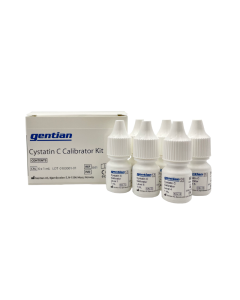
The Gentian Cystatin C Calibrator Kit has been designed for the calibration of the Gentian Cystatin C reagent, supporting accurate assessment of kidney function using one of today's most reliable renal biomarkers.
The Gentian GCAL® Calprotectin Calibrator Kit is specifically developed for the Gentian GCAL® PETIA assay. It provides reliable calibration for the quantitative determination of serum or plasma calprotectin, supporting inflammatory disease diagnostics.
By matching each calibrator to its corresponding reagent system, analytical performance and measurement reliability are optimized.
Multi-Analyte Calibrators for Routine Laboratory Diagnostics
Routine clinical chemistry laboratories often require efficient calibration of multiple analytical parameters.
Duocal® Multi is a versatile multi-analyte calibrator designed to simplify routine laboratory workflows while maintaining high analytical performance. It supports standardized calibration procedures and contributes to efficient laboratory operations.
Calibrators, Reagents and Quality Controls – Working Together
Reliable laboratory diagnostics require more than high-quality reagents alone. Reagents perform the analytical reaction. Calibrators establish the correct analytical measurement scale. Quality controls verify that the calibrated analytical system continues to perform within predefined specifications.
Together, these three components create a robust quality assurance process and support accurate laboratory diagnostics.
Supporting Quality Management and IVDR Compliance
Routine calibration plays an important role in laboratory quality management. Standardized calibration procedures support laboratories in maintaining consistent analytical performance and contribute to compliance with applicable regulatory and quality requirements, including IVDR and ISO 15189 accreditation processes.
Why Choose BIOMED Clinical Chemistry Calibrators?
BIOMED offers carefully selected clinical chemistry calibrators from leading manufacturers for professional laboratory use.
Our portfolio provides solutions for routine chemistry, specialized immunoassays and advanced biomarker testing.
Benefits include:
- High-quality clinical chemistry calibrators
- Multi-analyte calibration solutions
- Dedicated PETIA assay calibrators
- Excellent compatibility with corresponding reagents
- Reliable quantitative laboratory results
- Expert technical support for professional laboratories
Frequently Asked Questions
What is a clinical chemistry calibrator?
A calibrator is a reference material with known analyte concentrations used to establish the measurement scale of an analytical method.
Why is regular calibration important?
Routine calibration maintains analytical accuracy, minimizes systematic errors and ensures consistent quantitative laboratory results.
What is the difference between a calibrator and a quality control?
Calibrators establish the analytical measurement curve, whereas quality controls verify that the calibrated system continues to perform within acceptable limits.
Which calibrators does BIOMED offer?
BIOMED supplies multi-analyte clinical chemistry calibrators as well as dedicated calibrators for Gentian PETIA assays including Cystatin C and GCAL® Calprotectin.
Which laboratories are these calibrators intended for?
Our calibrators are designed for hospitals, clinical laboratories, diagnostic centers, university laboratories and other professional laboratory environments requiring reliable quantitative analytical performance.