




Orders placed before 12 noon
are usually dispatched on the same day (no dispatch on Fridays)
fT4 Rapid Test – Free Thyroxine
EAN: 06974464591432
Article number
5334C4X025
Packaging unit
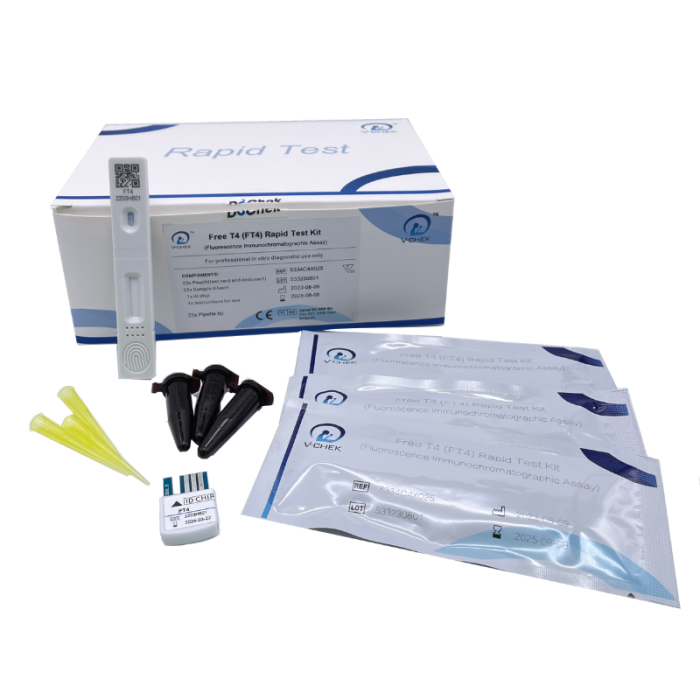
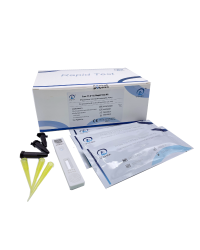
25 test cassettes, 25 pipette tips, 1 ID chip, sample dilution buffer
Quantitative fT4 rapid test for measurement of free thyroxine in serum, plasma and whole blood using the BIOspeed analyzer.
€270.00
Excl. 19% VAT ,
excl. Shipping Cost
fT4 Rapid Test Kit for Quantitative Measurement of Free Thyroxine
The fT4 Rapid Test Kit enables quantitative measurement of free thyroxine (fT4) in human serum, plasma and whole blood. fT4 is an important laboratory parameter for assessing thyroid function and is commonly evaluated together with TSH when investigating thyroid dysfunction.
Measurement is performed using the BIOspeed analyzer. After an incubation time of 15 minutes, the fT4 concentration is determined quantitatively.
What Is fT4?
fT4 stands for free thyroxine, also known as free tetraiodothyronine. Thyroxine (T4) is produced by the thyroid gland and released into the bloodstream. It is one of the two principal thyroid hormones and also serves as a precursor for the production of triiodothyronine (T3).
Most T4 in the blood is bound to transport proteins. Only a small proportion circulates unbound as free T4, referred to as fT4.
Measuring fT4 provides information about the concentration of free thyroxine in the blood and is an important part of thyroid function assessment.
What Is the Role of fT4 in Thyroid Diagnostics?
fT4 is generally not interpreted on its own but together with TSH and, when appropriate, other thyroid parameters.
TSH indicates how strongly the thyroid gland is being stimulated by the pituitary gland, while fT4 provides information about the concentration of free thyroxine in the blood. Considering both values together provides important information about thyroid function.
Depending on the clinical question, fT3, T3 and T4 may also be measured. Laboratory results are interpreted together with the patient's clinical findings and other relevant diagnostic information.
fT4 in Hypothyroidism and Hyperthyroidism
In hypothyroidism, the thyroid gland produces insufficient amounts of thyroid hormones. In primary hypothyroidism, fT4 is often decreased, while TSH is typically elevated.
In hyperthyroidism, thyroid hormone production is increased. fT4 may be elevated, while TSH is often decreased or suppressed.
Not every thyroid disorder follows these typical patterns. Different combinations of laboratory results may occur, particularly in disorders involving the pituitary gland or hypothalamus. fT4 and TSH are therefore interpreted in the context of other thyroid parameters and the clinical presentation.
Why Are fT4 and TSH Often Measured Together?
TSH and fT4 complement each other in the assessment of thyroid function.
TSH is produced by the pituitary gland and regulates thyroid hormone production. When thyroid hormone concentrations decrease, TSH secretion typically increases if the feedback system is intact. Conversely, increasing thyroid hormone concentrations suppress TSH secretion.
fT4 indicates the amount of free thyroxine circulating in the blood. Measuring TSH and fT4 together therefore helps to interpret changes in thyroid function more accurately.
fT4 and fT3 – What Is the Difference?
fT4 and fT3 are the free forms of the thyroid hormones T4 and T3.
fT4 (free thyroxine) is the unbound fraction of T4, which is produced predominantly by the thyroid gland. T4 also serves as an important precursor for the production of T3.
fT3 (free triiodothyronine) is the free form of the biologically more active T3. A substantial proportion of T3 is produced outside the thyroid gland through the conversion of T4.
The two parameters therefore provide different but complementary information about thyroid hormone status.
Free T4 and Total T4 – What Is the Difference?
Most T4 circulating in the blood is bound to transport proteins. Only a small proportion is present as free T4.
Total T4 measurement determines both protein-bound and free T4, whereas fT4 measurement specifically determines the free hormone fraction.
This distinction can be important when interpreting laboratory results. Changes in transport protein concentrations or binding properties can affect total T4 levels, while free T4 may be less directly affected.
Benefits of the fT4 Rapid Test Kit
- Quantitative measurement of free thyroxine (fT4)
- Suitable for serum, plasma and whole blood
- Results after 15 minutes
- Timely measurement at the point of care
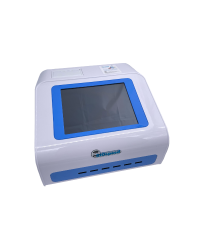
- Evaluation using the BIOspeed analyzer
- Compatible with BIOspeed Single and BIOspeed Multi
- Can be combined with additional thyroid parameters
Quantitative fT4 Measurement Using Fluorescence Immunoassay
The fT4 Rapid Test Kit uses a fluorescence immunochromatographic assay. Free T4 present in the sample binds to fluorescence-labelled anti-fT4 antibodies. Antibodies that remain unbound can subsequently bind to fT4 antigens immobilised on the test membrane.
The fluorescence signal is inversely related to the fT4 concentration: the more free T4 is present in the sample, the lower the fluorescence signal at the test line.
The BIOspeed analyzer measures the fluorescence signal and uses it to calculate the fT4 concentration. The required lot-specific calibration data are stored on the ID chip.
Performance Characteristics of the fT4 Rapid Test Kit
Parameter: fT4 (free thyroxine / free tetraiodothyronine)
Determination: Quantitative
Sample material: Serum, plasma or whole blood
Sample volume: 75 µL serum or plasma / 150 µL whole blood
Sample application: 75 µL of the prepared sample
Test principle: Fluorescence immunochromatographic assay
Evaluation: BIOspeed Single or BIOspeed Multi
Incubation time: 15 minutes
Kit contents: 25 test cassettes, sample dilution buffer, 25 pipette tips and 1 ID chip
Thyroid Parameters with BIOspeed
In addition to fT4, other important thyroid parameters can be measured quantitatively using the BIOspeed analyzer system, including TSH, fT3, T3 and T4.
TSH provides important information about pituitary regulation of the thyroid gland. fT4 and fT3 measure the free thyroid hormone fractions, while T4 and T3 determine the respective total hormone concentrations.
The choice of parameters depends on the clinical question. Combining several thyroid parameters can provide a more comprehensive assessment of thyroid function.
Timely fT4 Measurement with BIOspeed
The fT4 Rapid Test Kit enables quantitative measurement of free thyroxine within 15 minutes. Serum, plasma and whole blood can be used as sample materials.
The test is suitable for healthcare facilities that require quantitative fT4 measurement at the point of care and timely availability of results for further diagnostic assessment.
Further quantitative rapid tests and compatible analyzers are available in our BIOspeed Analyzers and Rapid Test Kits category.
| Parameter | fT4 |
|---|---|
| Packaging unit | 25 test cassettes, 25 pipette tips, 1 ID chip, sample dilution buffer |
Related Products
Check items to add to the cart or

