



Orders placed before 12 noon
are usually dispatched on the same day (no dispatch on Fridays)
TSH Rapid Test – Quantitative Measurement
EAN: 06974464591463
Article number
5284C4X025
Packaging unit
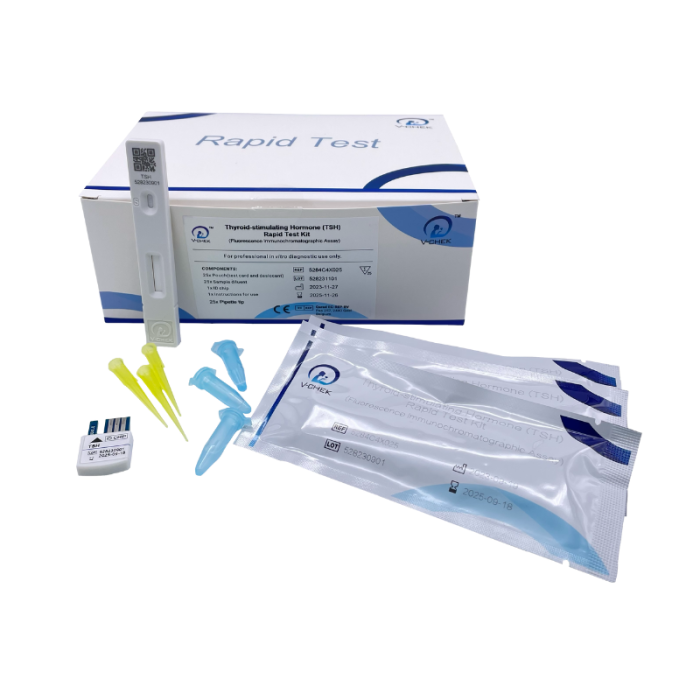
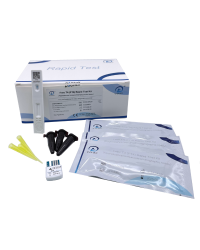
25 test cassettes, 25 pipette tips, 1 ID chip, sample dilution buffer
Quantitative TSH rapid test for measurement of thyroid-stimulating hormone in serum, plasma and whole blood using the BIOspeed analyzer.
€214.00
Excl. 19% VAT ,
excl. Shipping Cost
TSH Rapid Test Kit for Quantitative Measurement
The TSH Rapid Test Kit enables quantitative measurement of thyroid-stimulating hormone (TSH) in human serum, plasma and whole blood. TSH is a central laboratory parameter for the assessment of thyroid function and plays an important role in the diagnostic evaluation of thyroid dysfunction.
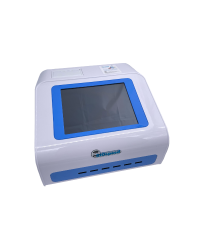
Quantitative measurement is performed using the BIOspeed analyzer. After an incubation time of 15 minutes, the TSH concentration is determined based on the fluorescence signal.
What Is TSH?
TSH, or thyroid-stimulating hormone, is produced by the anterior pituitary gland and is a key component of the regulatory axis between the pituitary gland and the thyroid.
TSH stimulates the thyroid gland to produce and release the thyroid hormones T4 (thyroxine) and T3 (triiodothyronine). Their concentrations, in turn, influence TSH secretion through a negative feedback mechanism.
This regulatory relationship makes TSH an important laboratory parameter for assessing thyroid function.
What Is the Role of TSH in Thyroid Diagnostics?
The TSH concentration provides important information about the functional relationship between the pituitary gland and the thyroid. Changes in TSH levels can indicate altered thyroid function.
For clinical interpretation, however, TSH should not be considered in isolation. In particular, fT4 and fT3 can provide additional information and help to interpret changes in TSH concentration.
This is especially important when laboratory results and the clinical presentation do not correspond. TSH results are therefore evaluated together with other thyroid parameters such as fT3, T3, fT4 and T4 as well as the available clinical and laboratory findings.
TSH in Hypothyroidism and Hyperthyroidism
TSH concentration is closely related to thyroid function through the hypothalamic-pituitary-thyroid regulatory axis.
In primary hypothyroidism, the thyroid gland does not produce sufficient amounts of thyroid hormones. Reduced negative feedback can consequently lead to increased secretion of TSH by the pituitary gland.
In primary hyperthyroidism, increased production of thyroid hormones typically results in suppression of TSH secretion through negative feedback.
This relationship explains why the combined assessment of TSH and thyroid hormones is particularly useful for the diagnostic evaluation of thyroid function.
Different patterns may occur in central disorders involving the pituitary gland or hypothalamus. TSH results should therefore always be interpreted within the clinical context and together with other relevant laboratory parameters.
Why Are TSH, fT3 and fT4 Evaluated Together?
TSH, fT3 and fT4 reflect different aspects of thyroid regulation.
While TSH reflects pituitary regulation of the thyroid gland, fT4 and fT3 provide information about the concentrations of free thyroid hormones.
Combining these parameters therefore allows a more differentiated assessment of thyroid function than evaluating an individual laboratory result alone.
For the diagnostic interpretation of a TSH result, additional thyroid parameters such as fT3, T3, fT4 and T4 as well as clinical and laboratory findings are taken into consideration.
Benefits of the TSH Rapid Test Kit
- Quantitative measurement of TSH
- Suitable for serum, plasma and whole blood
- Results after 15 minutes
- Timely measurement directly at the point of care
- Evaluation using the BIOspeed analyzer
- Compatible with BIOspeed Single and BIOspeed Multi
- Can be complemented by additional thyroid parameters
Quantitative TSH Measurement Using Fluorescence Immunoassay
The TSH Rapid Test Kit uses a fluorescence immunochromatographic assay for quantitative TSH measurement. TSH present in the patient sample binds to specific antibodies. The resulting immune complexes are captured on the test membrane and generate a measurable fluorescence signal.
As the TSH concentration increases, the fluorescence signal becomes stronger. The BIOspeed analyzer measures this signal and uses it to determine the quantitative TSH concentration in the sample.
The lot-specific calibration curve is stored on the corresponding ID chip. The BIOspeed analyzer calculates the TSH concentration based on the measured signal and the stored calibration data.
Performance Characteristics of the TSH Rapid Test Kit
Parameter: TSH (thyroid-stimulating hormone)
Determination: Quantitative
Sample material: Serum, plasma or whole blood
Sample volume: 75 µL serum, plasma or whole blood
Sample application: 75 µL of the prepared sample
Test principle: Fluorescence immunochromatographic assay
Evaluation: BIOspeed Single or BIOspeed Multi
Incubation time: 15 minutes
Kit contents: 25 test cassettes, sample dilution buffer, 25 pipette tips and 1 ID chip
TSH and Other Thyroid Parameters with BIOspeed
Thyroid function can be assessed more comprehensively by considering several laboratory parameters. In addition to TSH, T3, T4, fT3 and fT4 can be quantitatively measured using the BIOspeed analyzer system.
Each parameter provides different information. TSH primarily reflects pituitary regulation of the thyroid gland, whereas T3 and T4 and their free forms provide additional information about thyroid hormone status.
Depending on the diagnostic question, different thyroid parameters can therefore be quantitatively measured using the same BIOspeed analyzer system.
TSH Rapid Test for Point-of-Care Thyroid Diagnostics
The TSH Rapid Test Kit combines quantitative measurement of a key thyroid parameter with an incubation time of 15 minutes. Serum, plasma and whole blood can be used as sample materials.
The test is suitable for healthcare facilities requiring timely quantitative TSH measurement and interpretation of the result together with other thyroid parameters and clinical findings.
Further quantitative rapid tests and compatible analyzers are available in our BIOspeed Analyzers and Rapid Test Kits category.
| Parameter | TSH |
|---|---|
| Packaging unit | 25 test cassettes, 25 pipette tips, 1 ID chip, sample dilution buffer |
Related Products
Check items to add to the cart or

