



Orders placed before 12 noon
are usually dispatched on the same day (no dispatch on Fridays)
Rota-Adenovirus Schnelltest – mit Positivkontrollen
EAN: 04260481081028
Article number
110540
Packaging unit
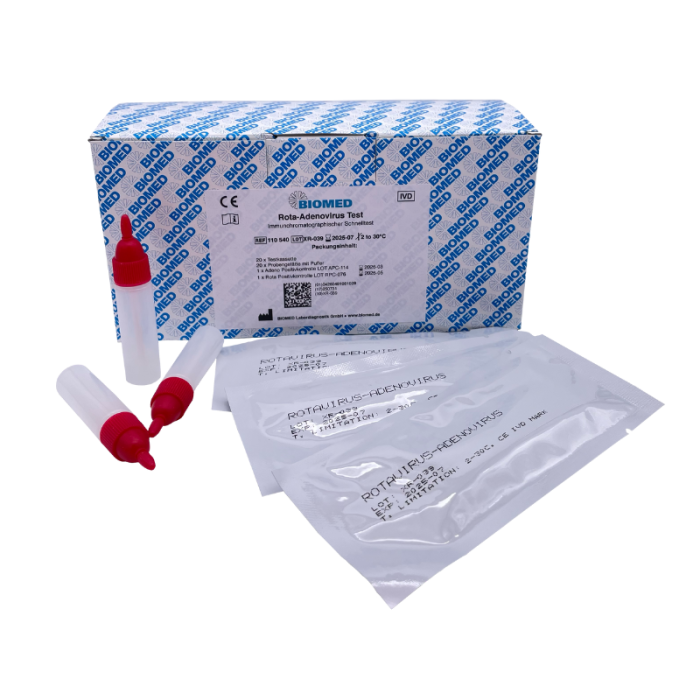
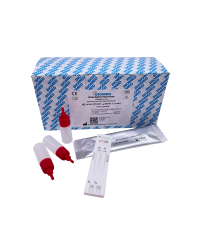
20 x test cassettes, 20 x sample vials with sample dilution buffer, 1x positive control each for adenovirus and rotavirus
Qualitative rapid test for the simultaneous detection and differentiation of rotavirus and adenovirus antigens in human stool specimens.
€85.00
Excl. 19% VAT ,
excl. Shipping Cost
Rota-Adenovirus Rapid Test – Combined Antigen Detection with External Positive Controls
The BIOMED Rota-Adenovirus Rapid Test is a qualitative immunochromatographic in vitro diagnostic assay for the simultaneous detection and differentiation of rotavirus and adenovirus antigens in human stool specimens.
This instrument-free lateral flow assay detects both viral pathogens in a single testing procedure. Separate test lines allow rotavirus and adenovirus to be identified individually, with visually interpretable results available after 10 minutes. The test supports the laboratory investigation of suspected viral gastroenteritis.
A key advantage of the BIOMED Rota-Adenovirus Rapid Test is the inclusion of two external positive controls – one for rotavirus and one for adenovirus. These provide additional verification of the respective antigen detection reactions and complement the integrated procedural control of the test cassette.
Each kit contains 20 test cassettes and ready-to-use sample collection tubes with dilution buffer, making it suitable for professional use in clinical laboratories, hospitals and medical practices.
What Are the Key Benefits of the BIOMED Rota-Adenovirus Rapid Test?
- Two viral pathogens in one test: Simultaneous qualitative detection of rotavirus and adenovirus antigens.
- Rapid results: Visual interpretation after 10 minutes.
- Two external positive controls included: Separate control materials for rotavirus and adenovirus to support additional quality assurance.
- Differentiated results: Separate test lines allow the two pathogens to be distinguished.
- Instrument-free testing: Immunochromatographic lateral flow technology without the need for a dedicated analyser.
- Different stool consistencies: Suitable for solid, semi-liquid and liquid stool specimens.
- Ready-to-use sample preparation: Sample collection tubes containing dilution buffer are included.
- 20 tests per kit: Designed for professional gastrointestinal infection diagnostics.
- Convenient storage: Store in the original packaging at +2 to +30 °C until the stated expiry date.
Why Is Combined Rotavirus and Adenovirus Detection Important?
Rotaviruses and enteric adenoviruses are important viral causes of acute gastroenteritis, particularly in infants and young children.
Both infections may present with similar gastrointestinal symptoms, including diarrhoea, vomiting, abdominal pain and fever. Distinguishing between these pathogens based on clinical presentation alone is therefore often difficult.
The combined rotavirus and adenovirus antigen test allows both pathogens to be investigated using a single stool specimen, supporting the aetiological assessment of gastrointestinal infections.
Rotavirus – An Important Cause of Acute Gastroenteritis
Rotaviruses are non-enveloped, double-stranded RNA viruses belonging to the family Reoviridae. They are primarily transmitted via the faecal-oral route and are highly infectious, making them particularly relevant in communal and healthcare settings.
Rotavirus infections may cause significant gastrointestinal symptoms, including watery diarrhoea and vomiting. Infants and young children are particularly vulnerable to clinically relevant dehydration.
Direct antigen detection in stool specimens supports the diagnostic investigation of suspected rotavirus gastroenteritis.
Adenovirus – A Viral Pathogen Associated with Gastrointestinal Infections
Adenoviruses are non-enveloped DNA viruses capable of causing a variety of clinical conditions. In addition to respiratory infections and conjunctivitis, certain adenovirus types can cause gastrointestinal disease.
Enteric adenovirus types 40 and 41 are particularly associated with acute gastroenteritis. Infections may present with prolonged diarrhoea, vomiting and fever.
Detection of adenovirus antigens in stool provides additional information when investigating a possible viral cause of gastrointestinal symptoms.
Combined rotavirus and adenovirus testing allows both pathogens to be detected qualitatively and differentiated within a single testing procedure.
Two External Positive Controls Included – Additional Quality Assurance
Reliable quality control is an essential component of professional laboratory diagnostics.
The BIOMED Rota-Adenovirus Rapid Test combines an integrated procedural control with two separate external positive controls.
Internal Procedural Control
Each test cassette contains an integrated control line (C).
The appearance of the green control line confirms that sufficient sample volume has been applied, adequate lateral flow has occurred and the internal procedural control has functioned correctly.
External Positive Controls for Rotavirus and Adenovirus
Each kit additionally includes two separate external positive controls:
- Rotavirus positive control: A control swab containing purified, inactivated rotavirus antigens.
- Adenovirus positive control: A control swab containing purified, inactivated adenovirus antigens.
The positive controls are prepared and tested in the same manner as patient specimens. They allow the respective positive antigen detection reactions to be checked independently.
Successful testing of each control produces the corresponding red test line together with the green control line.
External quality control therefore complements the integrated procedural control and provides an additional means of verifying test performance.
Your advantage: Both external positive controls are already included in the BIOMED test kit and do not need to be purchased separately.
How Does the Rota-Adenovirus Rapid Test Work?
The assay is based on a qualitative immunochromatographic lateral flow method.
The test cassette contains a reactive test strip with specific monoclonal antibodies directed against rotavirus and adenovirus antigens.
Following sample preparation, the diluted stool specimen is applied to the test strip. The sample migrates along the membrane by capillary action. If the corresponding viral antigens are present, specific antigen-antibody reactions produce coloured test lines.
Results are visually interpreted after 10 minutes:
- Adenovirus positive: A red test line at T1 and a green control line at C.
- Rotavirus positive: A red test line at T2 and a green control line at C.
- Rotavirus and adenovirus positive: Red test lines at T1 and T2, together with the green control line at C.
- Negative: Only the green control line at C is visible.
- Invalid: The green control line is absent, shows irregular coloration or non-specific colour changes occur. Testing must be repeated.
Test line intensity may vary depending on the antigen concentration in the specimen. The assay is qualitative and does not provide a quantitative measurement of viral antigen levels.
Test lines appearing after the specified reading time have no diagnostic value.
Which Stool Specimens Can Be Tested?
The BIOMED Rota-Adenovirus Rapid Test is intended for the analysis of human stool specimens.
The assay can process different stool consistencies:
- Solid stool specimens
- Semi-liquid stool specimens
- Liquid stool specimens
Fresh, untreated specimens are recommended for optimal test performance.
Specimen collection should preferably take place as soon as possible after the onset of gastrointestinal symptoms, as viral shedding may be particularly high during the early stages of infection.
If immediate testing is not possible, specimens may be stored at +2 to +8 °C for one to two days. Longer storage at −20 °C is possible, although changes in antigen immunoreactivity cannot be excluded.
Specimens containing preservatives, transport media or enrichment media should not be used, as these substances may interfere with assay performance.
Heavily blood-contaminated stool specimens may cause non-specific reactions that affect the reliability of test results.
How Reliable Is the Rota-Adenovirus Rapid Test?
The BIOMED Rota-Adenovirus Rapid Test has been evaluated for diagnostic sensitivity and specificity.
Rotavirus Detection
In comparison with a commercially available rotavirus rapid test, the following performance characteristics were obtained:
- Diagnostic sensitivity: Greater than 99%
- Diagnostic specificity: 98%
Adenovirus Detection
In comparison with a PCR reference method, the following performance characteristics were obtained:
- Diagnostic sensitivity: Greater than 99%
- Diagnostic specificity: Greater than 99%
These performance characteristics relate to the respective comparison methods. In particular, the rotavirus results should not be interpreted as clinical performance established against a PCR-based reference method.
Cross-Reactivity
No interference with test results was observed at the evaluated concentrations of various other gastrointestinal pathogens.
The microorganisms investigated included:
- Norovirus, astrovirus and enterovirus
- Campylobacter spp. and Salmonella spp.
- Clostridioides difficile and Escherichia coli
- Giardia lamblia and Cryptosporidium parvum
These findings apply to the microorganisms and test conditions evaluated.
Limitations of Diagnostic Interpretation
A negative result does not completely exclude rotavirus or adenovirus infection. Low antigen concentrations, inappropriate specimen storage or specimen collection at an unsuitable stage of infection may affect detectability.
Following recent oral vaccination with RotaTeq, positive rotavirus test results may occur within 15 days of vaccination.
A positive antigen result does not necessarily establish that the detected virus is solely responsible for the patient's clinical symptoms. Co-infections with other pathogens are also possible.
Final interpretation must take into account the patient's clinical presentation and, where appropriate, additional laboratory investigations.
What Is Included in the Rota-Adenovirus Rapid Test Kit?
Each kit contains:
- 20 Rota-Adenovirus test cassettes
- 20 sample collection tubes containing dilution buffer
- 1 external rotavirus positive control
- 1 external adenovirus positive control
Additional materials required for testing include disposable gloves, a vortex mixer and a timer.
Storage and Stability
The Rota-Adenovirus Rapid Test can be stored in its original, unopened packaging at temperatures between +2 and +30 °C until the indicated expiry date.
Do not freeze the test components or positive controls.
Once the aluminium pouch has been opened, the test cassette must be used within 2 hours.
Frequently Asked Questions About the Rota-Adenovirus Rapid Test
What Does the Rota-Adenovirus Rapid Test Detect?
The assay enables the simultaneous qualitative detection of rotavirus and adenovirus antigens in human stool specimens. The two pathogens are differentiated using separate test lines.
How Quickly Are Results Available?
Results can be visually interpreted after 10 minutes. No dedicated analyser is required.
Can Rotavirus and Adenovirus Be Detected from a Single Stool Specimen?
Yes. Only one stool specimen is required for the combined detection of both pathogens. The test cassette allows rotavirus and adenovirus results to be interpreted separately.
Are Positive Controls Included in the Test Kit?
Yes. Each kit contains two separate external positive controls: one for rotavirus and one for adenovirus. They provide an additional means of verifying the respective antigen detection reactions.
What Does a Positive Rota-Adenovirus Test Result Mean?
A positive result indicates the presence of the respective viral antigen in the examined stool specimen. In patients with compatible clinical symptoms, this finding supports the suspicion of rotavirus or adenovirus infection.
Does a Negative Result Rule Out Rotavirus or Adenovirus Infection?
No. A negative result does not completely exclude infection. Additional diagnostic investigations may be necessary if clinical suspicion persists.
Can the Test Be Used in Children?
The assay is intended for qualitative antigen detection in human stool specimens and can support the diagnostic investigation of gastrointestinal infections in children. Testing must be performed by appropriately trained healthcare professionals.
Does the Rota-Adenovirus Rapid Test Require an Analyser?
No. The immunochromatographic assay is interpreted visually and does not require a dedicated analyser.
Order the Rota-Adenovirus Rapid Test from BIOMED
The BIOMED Rota-Adenovirus Rapid Test combines qualitative detection of rotavirus and adenovirus antigens in a single test cassette, supporting the rapid laboratory investigation of viral gastroenteritis.
With 10-minute results, ready-to-use sample preparation components and two included external positive controls, the test kit offers a practical solution for professional gastrointestinal infection diagnostics.
Explore our range of Point-of-Care Rapid Tests for additional diagnostic solutions in gastrointestinal and respiratory testing.
| Parameter | Adenovirus antigen, Rotavirus antigen |
|---|---|
| Packaging unit | 20 x test cassettes, 20 x sample vials with sample dilution buffer, 1x positive control each for adenovirus and rotavirus |
Related Products
Check items to add to the cart or

