




Orders placed before 12 noon
are usually dispatched on the same day (no dispatch on Fridays)
Ferritin Rapid Test – Quantitative Ferritin Measurement
EAN: 06974464591623
Article number
5414C4X025
Packaging unit
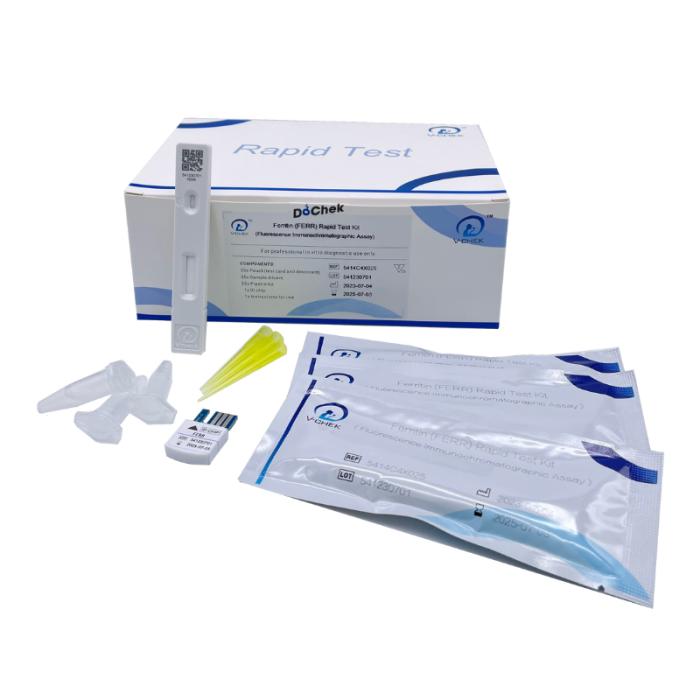
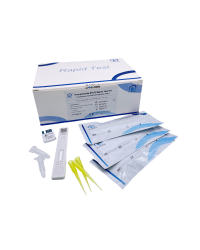
25 test cassettes, 25 pipette tips, 1 ID chip, sample dilution buffer
Quantitative ferritin rapid test for measurement of ferritin in serum, plasma and whole blood using the BIOspeed analyzer. Results available after 10 minutes.
€172.50
Excl. 19% VAT ,
excl. Shipping Cost
Ferritin Rapid Test Kit for Quantitative Measurement
The Ferritin Rapid Test Kit enables the quantitative measurement of ferritin (FERR) in human serum, plasma and whole blood. Ferritin is an important laboratory parameter for assessing iron metabolism and the body's iron stores. Ferritin measurement is particularly useful in the assessment of suspected iron deficiency and in the differential diagnosis of anemia.
At the same time, ferritin is an acute-phase protein. During inflammatory processes, ferritin concentrations can increase independently of the body's actual iron stores. Clinical context is therefore essential when interpreting ferritin results. In patients with inflammation, additional laboratory parameters such as CRP and transferrin should be considered.
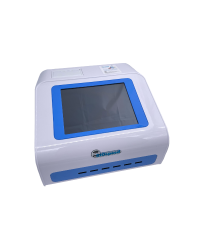
Quantitative measurement is performed using the BIOspeed analyzer. After an incubation time of 10 minutes, the ferritin result is available.
What Is Ferritin?
Ferritin is a protein that binds iron and stores it in a form that can be made available to the body when required. It is found primarily in the liver, spleen and bone marrow. A small proportion circulates in the blood and can be measured as serum or plasma ferritin.
Ferritin concentrations in the blood generally reflect the body's iron stores. Low ferritin concentrations are therefore an important indication of depleted iron stores and possible iron deficiency.
The interpretation of elevated ferritin concentrations is more complex. In addition to increased iron stores, inflammatory processes can influence ferritin levels.
What Is the Role of Ferritin in Iron Deficiency?
Ferritin measurement is one of the most important laboratory investigations when iron deficiency is suspected.
As the body's iron stores become depleted, ferritin concentrations usually decrease. A low ferritin result can therefore indicate iron deficiency even before pronounced iron deficiency anemia develops.
For diagnostic assessment, ferritin and other parameters of iron metabolism are evaluated together with the complete blood count and the patient's clinical findings.
What Is the Role of Ferritin in the Diagnosis of Anemia?
Anemia can have many different causes. Iron deficiency is one of the most common, but it is not the only possible cause.
Ferritin helps assess whether depleted iron stores may be contributing to anemia. Ferritin measurement therefore plays an important role in the differential diagnosis of anemia.
Of particular relevance is the distinction between iron deficiency anemia and anemia associated with chronic inflammatory conditions. During inflammation, ferritin concentrations may be normal or elevated despite restricted iron availability.
Why Can Ferritin Be Elevated During Inflammation?
Ferritin is not only an iron-storage protein but also an acute-phase protein.
As part of the acute-phase response, ferritin concentrations can increase during inflammatory processes. A normal or elevated ferritin result in a patient with inflammation therefore does not necessarily indicate adequate iron stores.
For this reason, ferritin should not be interpreted in isolation when inflammation is present. Inflammatory markers such as CRP, together with additional parameters of iron metabolism, can provide important complementary information.
Ferritin and CRP – Why Are Both Parameters Assessed Together?
Ferritin and CRP provide different diagnostic information.
Ferritin is primarily used to assess iron metabolism and iron stores. However, ferritin concentrations can also increase as part of an inflammatory response.
CRP is an established marker of inflammatory activity. An elevated CRP concentration can therefore provide important additional information when interpreting a ferritin result.
For example, if ferritin is normal or elevated while a pronounced inflammatory response is present, the effect of the acute-phase response on ferritin needs to be considered.
The combined assessment of ferritin, CRP and other laboratory parameters can therefore be particularly useful in the differential diagnosis of anemia. Ferritin results should be interpreted together with other markers such as CRP or transferrin and the available clinical and laboratory findings.
What Does a Low Ferritin Level Mean?
A low ferritin concentration generally indicates depleted iron stores and is an important laboratory finding in iron deficiency.
Depending on the severity and stage of the deficiency, changes in hemoglobin and other red blood cell parameters may also occur.
Once iron deficiency has been identified, its underlying cause should be investigated clinically.
What Does an Elevated Ferritin Level Mean?
An elevated ferritin result is less specific than a low ferritin result.
Ferritin concentrations can increase in association with inflammatory processes. An elevated ferritin concentration alone therefore does not demonstrate adequate iron stores and does not establish a specific diagnosis.
Clinical context and additional laboratory parameters are essential for interpretation.
Benefits of the Ferritin Rapid Test Kit
- Quantitative measurement of ferritin (FERR)
- Assessment of iron metabolism and iron stores
- Supports the differential diagnosis of anemia
- Ferritin is also relevant in the context of inflammatory processes
- Suitable for serum, plasma and whole blood
- Result after 10 minutes
- Quantitative analysis using the BIOspeed analyzer
- Compatible with BIOspeed Single and BIOspeed Multi
How Does the Quantitative Ferritin Rapid Test Work?
The Ferritin Rapid Test Kit is based on a fluorescence immunochromatographic assay using a double-antibody sandwich method.
Ferritin in the sample binds to fluorescence-labelled anti-ferritin antibodies. The resulting immune complexes migrate along the test membrane and bind to another anti-ferritin antibody immobilized on the test strip.
As the ferritin concentration increases, the intensity of the fluorescence signal increases. The BIOspeed analyzer measures this signal and uses it to quantitatively determine the ferritin concentration.
The lot-specific calibration curve is stored on the ID chip and used by the BIOspeed analyzer to calculate the ferritin concentration.
Performance Characteristics of the Ferritin Rapid Test Kit
Parameter: Ferritin (FERR)
Measurement: Quantitative
Sample material: Serum, plasma or whole blood
Sample volume: 75 µL serum, plasma or whole blood
Sample application: 75 µL of the prepared sample
Test principle: Fluorescence immunochromatographic assay
Analysis: BIOspeed Single or BIOspeed Multi
Incubation time: 10 minutes
Kit contents: 25 test cassettes, sample dilution buffer, 25 pipette tips and 1 ID chip
Ferritin and Other Inflammatory Markers with BIOspeed
In addition to ferritin, further quantitative tests are available for the BIOspeed analyzer system, including PCT, CRP, IL-6 and SAA.
The diagnostic applications of these biomarkers differ considerably. Ferritin is primarily used to assess iron metabolism and iron stores. Its role as an acute-phase protein also makes it relevant when interpreting laboratory findings in the presence of inflammation.
CRP, PCT, IL-6 and SAA provide different information about inflammatory and infectious processes. The selection and combination of biomarkers depend on the individual clinical question.
Quantitative Ferritin Results in 10 Minutes with BIOspeed
The Ferritin Rapid Test Kit enables quantitative measurement of ferritin within 10 minutes. Serum, plasma and whole blood can be used as sample material.
The test is suitable for healthcare settings where timely ferritin measurement is required, for example when assessing iron metabolism, investigating suspected iron deficiency or supporting the differential diagnosis of anemia.
Further quantitative rapid tests and the corresponding analyzers are available in the BIOspeed Analyzers and Rapid Test Kits category.
Frequently Asked Questions About Ferritin
What Does a Ferritin Test Show?
Ferritin is primarily used as a laboratory parameter to assess the body's iron stores. Low ferritin concentrations can indicate depleted iron stores and iron deficiency.
Is Ferritin an Inflammatory Marker?
Ferritin is primarily an iron-storage protein, but it is also an acute-phase protein. Ferritin concentrations can increase during inflammatory processes. When inflammation is present, ferritin should therefore be interpreted together with other laboratory parameters.
Why Are Ferritin and CRP Measured Together?
CRP can provide information about the presence of an inflammatory response. This is relevant when interpreting ferritin because inflammation can increase ferritin concentrations.
Can Iron Deficiency Be Present Despite Normal Ferritin?
In the presence of inflammation, ferritin concentrations can increase as part of the acute-phase response. A normal or elevated ferritin result therefore does not necessarily exclude iron deficiency in this clinical setting. Additional parameters of iron metabolism and inflammatory activity should be considered.
How Long Does the Ferritin Rapid Test Take?
The incubation time is 10 minutes. The ferritin concentration is then quantitatively determined using the BIOspeed analyzer.
| Parameter | Ferritin |
|---|---|
| Packaging unit | 25 test cassettes, 25 pipette tips, 1 ID chip, sample dilution buffer |
Related Products
Check items to add to the cart or

