




Orders placed before 12 noon
are usually dispatched on the same day (no dispatch on Fridays)
IL-6 Rapid Test – Quantitative Interleukin-6
EAN: 06974464591524
Article number
5384C4X025
Packaging unit
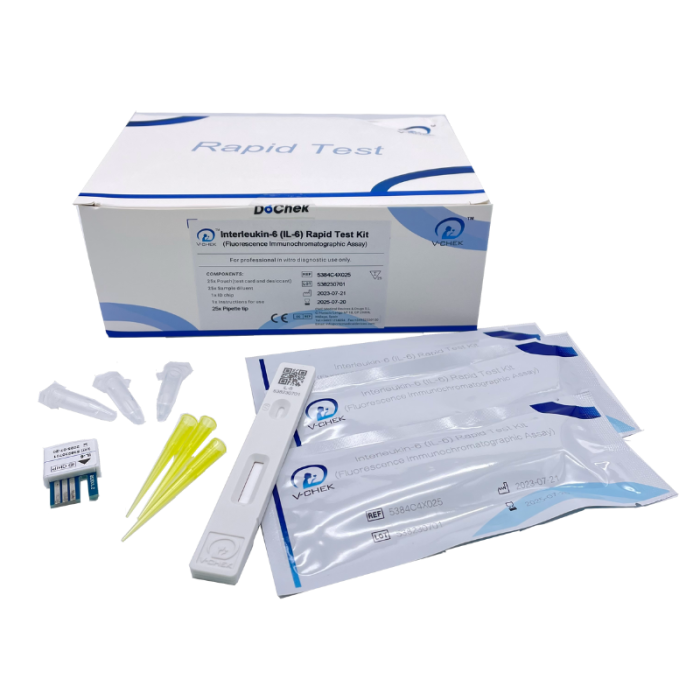
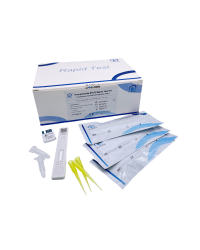
25 test cassettes, 25 pipette tips, 1 ID chip, sample dilution buffer
Quantitative IL-6 rapid test for measurement of interleukin-6 in serum, plasma and whole blood using BIOspeed Single or BIOspeed Multi. Suitable for the assessment of acute infections and particularly relevant for neonatal diagnostic applications.
€298.00
Excl. 19% VAT ,
excl. Shipping Cost
IL-6 Rapid Test Kit for Quantitative Measurement of Interleukin-6
The IL-6 Rapid Test Kit enables the quantitative measurement of interleukin-6 (IL-6) in human serum, plasma and whole blood. IL-6 is a pro-inflammatory cytokine and an important mediator of the immune response. It is involved in the regulation of inflammatory processes and can be released during the early stages of an acute inflammatory response.
Quantitative IL-6 measurement can provide additional diagnostic information in the assessment of acute infections. A particularly relevant field of application is neonatology, where IL-6 has been investigated as an early inflammatory biomarker in suspected neonatal infection and sepsis.
The IL-6 Rapid Test Kit is designed for quantitative measurement in serum, plasma and whole blood using the BIOspeed analyzer.
After sample application, the test cassette is incubated for 15 minutes and subsequently analyzed quantitatively.
What Is Interleukin-6 (IL-6)?
Interleukin-6, or IL-6, is a cytokine involved in immune regulation. Cytokines are signaling molecules that enable communication between cells and coordinate immune responses.
IL-6 can be released by different cell types in response to infectious and inflammatory stimuli. It is involved in numerous immunological processes and plays an important role in regulating the acute-phase response.
IL-6 concentrations in the blood can increase following activation of the immune system. Quantitative IL-6 measurement makes it possible to assess this response in conjunction with the patient's clinical condition and other diagnostic findings.
Why Is IL-6 Relevant as an Early Inflammatory Marker?
IL-6 is involved in the early stages of the immune response. Following an appropriate inflammatory stimulus, the cytokine can be released at an early stage.
This makes IL-6 particularly relevant in clinical situations where early assessment of an inflammatory or infectious response is required.
IL-6 concentrations must always be interpreted in their temporal and clinical context. A single IL-6 result cannot independently determine the cause of an inflammatory response or confirm or exclude an infection or sepsis.
What Is the Role of IL-6 in Acute Infections?
During an acute infection, the innate immune system responds by releasing various inflammatory mediators. IL-6 is one of the cytokines involved in this early immune response.
Quantitative IL-6 measurement can therefore provide additional information about activation of the inflammatory response and support the assessment of acute infections. This is one of the intended diagnostic applications of the IL-6 Rapid Test Kit.
However, the IL-6 concentration is not specific to a particular pathogen or disease. Results should therefore always be interpreted together with the clinical presentation and other laboratory findings.
What Is the Role of IL-6 in Neonatology?
Neonatology is a particularly relevant field for IL-6 measurement. Clinical signs of infection or sepsis in preterm and term newborns can be non-specific, while early diagnostic assessment is especially important.
IL-6 has therefore been extensively investigated as an early biomarker of neonatal infection and neonatal sepsis. The scientific literature referenced for the IL-6 Rapid Test Kit includes several studies addressing the early diagnosis of neonatal bacterial infection and neonatal sepsis.
Research into early-onset neonatal sepsis indicates that the timing of sample collection is an important factor influencing the diagnostic performance of IL-6. In a systematic review of 31 studies involving 3,276 neonates, the highest sensitivity was observed when IL-6 was measured early, at the time sepsis was first suspected.
This makes IL-6 an interesting laboratory biomarker for neonatal diagnostic situations in which early assessment of the immune and inflammatory response is required.
IL-6 in Suspected Neonatal Sepsis
The diagnosis of neonatal sepsis can be challenging because clinical signs in newborns are often non-specific. Laboratory biomarkers can therefore provide important additional information as part of the overall diagnostic assessment.
IL-6 has been investigated in both early-onset neonatal sepsis (EONS) and late-onset neonatal sepsis (LONS). Studies indicate diagnostic potential, although results vary according to factors such as the population studied, gestational age, timing of sample collection and the thresholds applied.
An IL-6 result should therefore not be interpreted in isolation as confirmation or exclusion of neonatal sepsis. Clinical assessment of the newborn, additional laboratory parameters and, where appropriate, microbiological findings remain essential.
The early dynamics of IL-6 are one of the characteristics that make this biomarker particularly interesting in neonatal diagnostics.
Why Does the Timing of IL-6 Measurement Matter?
The timing of sample collection is an important consideration when interpreting IL-6 results.
Because IL-6 participates in the early stages of the immune response, its concentration can change dynamically over time. An IL-6 result should therefore always be interpreted in relation to the timing and course of the suspected infection or inflammatory response.
This aspect is particularly relevant in neonatology. Studies of early-onset neonatal sepsis indicate that early IL-6 measurement at the time sepsis is first suspected can provide useful diagnostic information.
Quantitative IL-6 measurement therefore provides a result whose clinical significance depends on the combination of IL-6 concentration, timing of measurement, clinical condition and additional diagnostic findings.
Interpreting IL-6 Results in the Clinical Context
An elevated IL-6 concentration indicates activation of inflammatory processes but is not specific to a particular disease.
Interpretation should therefore always take into account the clinical situation and additional laboratory parameters. This is particularly important in complex clinical conditions and when assessing newborns with suspected infection.
Results obtained with the IL-6 Rapid Test Kit should be interpreted together with other immune biomarkers and all available clinical and laboratory findings.
Benefits of the IL-6 Rapid Test Kit
- Quantitative measurement of interleukin-6 (IL-6)
- Supports the assessment of acute infections
- Relevant early inflammatory biomarker for neonatal diagnostic applications
- Suitable for serum, plasma and whole blood
- Quantitative fluorescence immunoassay analysis
- 15-minute incubation time
- Quantitative analysis using the BIOspeed analyzer
- Compatible with BIOspeed Single and BIOspeed Multi
- Can be combined with additional inflammatory and infection biomarkers
How Does the Quantitative IL-6 Rapid Test Work?
The IL-6 Rapid Test Kit is based on a fluorescence immunochromatographic assay using a double-antibody sandwich method.
IL-6 in the patient sample binds to fluorescence-labelled anti-IL-6 antibodies. The resulting immune complexes migrate along the nitrocellulose membrane and bind to another anti-IL-6 antibody immobilized on the test strip.
As the IL-6 concentration increases, the intensity of the fluorescence signal increases. The BIOspeed analyzer measures this signal and uses it to quantitatively determine the IL-6 concentration.
The lot-specific calibration curve is stored on the ID chip and is used by the BIOspeed analyzer to calculate the IL-6 concentration.
Performance Characteristics of the IL-6 Rapid Test Kit
Parameter: Interleukin-6 (IL-6)
Measurement: Quantitative
Sample material: Serum, plasma or whole blood
Sample volume: 75 µL serum, plasma or whole blood
Sample application: 75 µL of the prepared sample
Test principle: Fluorescence immunochromatographic assay
Analysis: BIOspeed analyzer
Incubation time: 15 minutes
Kit contents: 25 test cassettes, sample dilution buffer, 25 pipette tips and 1 ID chip
The test procedure uses 75 µL of the patient sample for sample preparation followed by application of 75 µL of the prepared sample to the test cassette. Following 15 minutes of external incubation, the cassette is immediately analyzed.
The kit contains 25 tests.
Quantitative IL-6 Measurement with BIOspeed Single and BIOspeed Multi
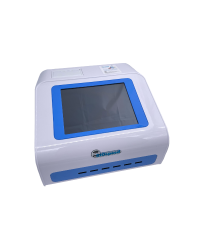
Quantitative analysis of the IL-6 Rapid Test is performed using the BIOspeed analyzer system.
Two analyzer configurations are available to meet different requirements in laboratories and near-patient diagnostic settings.
BIOspeed Single enables quantitative analysis of individual tests and is particularly suitable when tests are performed individually according to clinical demand.
BIOspeed Multi provides six test channels, enabling several tests to be processed in parallel.
IL-6 and Complementary Inflammatory Markers
IL-6 is not interpreted in isolation when assessing infections and inflammatory responses. Depending on the clinical question, additional laboratory biomarkers can provide complementary information.
These include C-reactive protein (CRP), procalcitonin (PCT) and serum amyloid A (SAA). These biomarkers reflect different aspects of the immune and inflammatory response and can therefore complement IL-6 measurement in clinical assessment.
The BIOspeed analyzer system supports quantitative measurement of IL-6 as well as additional inflammatory and infection biomarkers.
Quantitative IL-6 Measurement with BIOspeed
The IL-6 Rapid Test Kit enables the quantitative measurement of interleukin-6 in serum, plasma and whole blood. It supports the assessment of acute infections and provides access to a biomarker that is particularly relevant because of its involvement in the early immune response.
IL-6 measurement is of particular interest in neonatology, where the biomarker has been investigated in suspected neonatal infections and sepsis. Results should always be interpreted together with the newborn's clinical condition and other diagnostic findings.
After sample application, the test cassette is incubated for 15 minutes and subsequently analyzed quantitatively using the BIOspeed analyzer.
Depending on testing requirements, quantitative analysis can be performed using BIOspeed Single or BIOspeed Multi.
Explore our complete range of quantitative rapid tests and analyzers in the BIOspeed Analyzers and Rapid Test Kits category.
Frequently Asked Questions About IL-6 and the IL-6 Rapid Test
What Is IL-6?
Interleukin-6 (IL-6) is a cytokine and signaling molecule of the immune system. It is involved in the regulation of immune and inflammatory responses and plays an important role in the acute-phase response.
What Does an Elevated IL-6 Level Indicate?
An elevated IL-6 concentration can indicate activation of inflammatory processes. However, IL-6 is not specific to a single disease. The result should therefore be interpreted together with the patient's clinical condition and other diagnostic findings.
Why Is IL-6 Considered an Early Inflammatory Marker?
IL-6 is a pro-inflammatory signaling molecule that can be released during the early stages of an immune response. Quantitative IL-6 measurement can therefore provide information about early activation of inflammatory processes.
What Is the Role of IL-6 in Neonatology?
IL-6 has been investigated as an early biomarker in neonatal infections and neonatal sepsis. Its early release makes it particularly interesting in neonatal diagnostics, where timely assessment of a suspected infection is important.
What Is the Role of IL-6 in Early-Onset Neonatal Sepsis?
IL-6 has been extensively studied as an early biomarker in suspected early-onset neonatal sepsis (EONS). Available evidence indicates that the timing of sample collection is particularly important for its diagnostic performance.
An IL-6 result should not be used in isolation to confirm or exclude neonatal sepsis. Clinical assessment and additional laboratory and microbiological findings remain essential.
Can the IL-6 Rapid Test Diagnose Neonatal Sepsis?
No single IL-6 measurement independently establishes or excludes a diagnosis of neonatal sepsis. IL-6 can provide additional diagnostic information and should be interpreted together with clinical findings and other laboratory parameters.
Which Samples Can Be Used with the IL-6 Rapid Test?
The IL-6 Rapid Test Kit is suitable for human serum, plasma and whole blood.
How Long Does the IL-6 Rapid Test Take?
The incubation time is 15 minutes. When external incubation is used, the test cassette is inserted into the BIOspeed analyzer immediately after incubation for quantitative analysis.
Which BIOspeed Analyzers Can Be Used for IL-6 Measurement?
The IL-6 Rapid Test Kit can be quantitatively analyzed using BIOspeed Single or BIOspeed Multi. The appropriate analyzer can be selected according to the required testing workflow and sample throughput.
| Parameter | IL-6 |
|---|---|
| Packaging unit | 25 test cassettes, 25 pipette tips, 1 ID chip, sample dilution buffer |
Related Products
Check items to add to the cart or

